
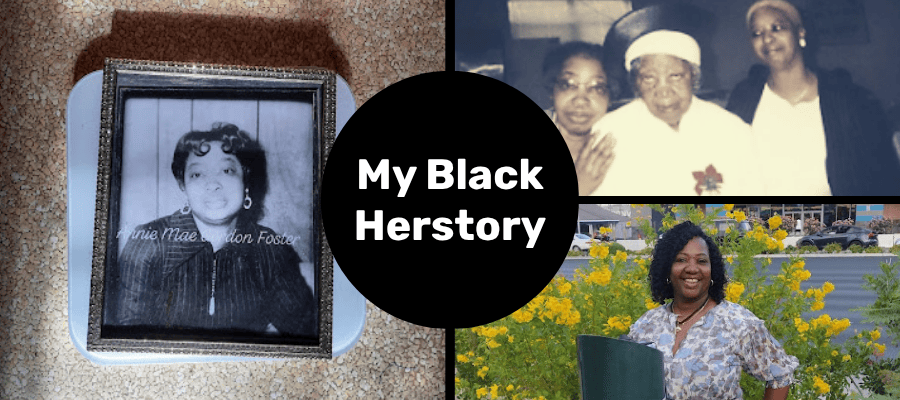
My Black Herstory
by Nyla, Digital Equality Organizer
February often asks Black people to compress ourselves. To explain centuries of survival in a few weeks. To perform remembrance on a schedule. Black history does not begin in February, and it does not end when the month does. Still, we honor it. Not because a calendar tells us to, but because remembering is part of how we stay whole.
For Black families, history lives forward. It shapes how children are raised, how money is understood, how people decide when it is time to move, and how care is passed down when the world refuses to provide it.
My family’s story moves between Edwards, Mississippi, and Kansas City, Missouri, across generations of Black women who understood that survival sometimes meant staying and sometimes meant leaving. Both required courage.
My great-grandmother, Mary Ella Gordon, was born in 1919 in Edwards, Mississippi. She became a mother at seventeen, during the Great Depression and under Jim Crow. In her world, opportunity was limited by design. Survival required discipline, silence, and preparation. She worked in other people’s homes, raised her children alongside theirs, and learned that money could vanish without warning. Saving was not a habit. It was protection. Security had to be built quietly, piece by piece.
My grandmother, Annie Mae, was born in 1936, also in Edwards. She had her first child in 1952, at just sixteen years old, in a South where segregation was law and safety was conditional. Responsibility arrived early. Pride became armor. She raised her children with discipline and care, knowing Black families were judged harshly and given little room for error. Stability mattered deeply to her. It meant that her family thrived in a world determined to question their worth.
Like many Black families, mine eventually migrated to Kansas City, Missouri, drawn by the promise of work, opportunity, and more equal access. They moved believing geography might soften what Mississippi could not. Some doors did open. Others stayed closed. That contradiction shaped everything that followed, and it still shows up today. Migration offered possibility, but it did not erase inequality.
My mother, Mary Foster, was born in 1961 and raised her family in Kansas City. She became a mother at twenty-seven, in 1988, during an era that promised progress while introducing new forms of control. Even as laws changed, access remained uneven. It had only been fourteen years, since 1974, that women in the United States could legally open a bank account or access credit without a husband or male co-signer. That reality shaped how Black women understood money long after the law changed.
Now I understand why my grandmother took pride in saving. Why she valued nice cars. Why stability was something you showed, not just felt. For Black women who had lived without financial autonomy for generations, money was dignity. It was evidence. It was freedom made visible.
I was born in 1988, raised in Kansas City, and grew up in the 1990s, shaped by migration and its limits. I learned early that opportunity was often promised more than it was delivered. I also learned how to observe, adapt, and imagine myself forward.
In the summer of 2001, when I was thirteen, I met Korea Kelly. Over time, she became my chosen mother, a matriarch formed through care, guidance, and years of showing up. What began as connection grew into decades of memory. Cooking together. Talking through decisions. Learning how to move in a community with intention and accountability. From her, I learned that leadership does not always announce itself. Sometimes it looks like patience. Like discernment. Like knowing when to step in and when to let someone grow.
Chosen family is not separate from Black history. It is one of the ways Black people, especially queer and trans people, have always survived. When blood relatives were stretched thin by systems designed to exhaust them, we built networks of care that carried us forward anyway.
In the summer of 2003, at fifteen years old, I transitioned. There was no roadmap. No widespread language. No protection. My being trans is not a break in my family’s story. It is another layer added to it. Another way resilience shows up. I was navigating systems my family had already learned to survive, now through the added lens of gender. The instincts I relied on were inherited, reinforced by both blood lineage and chosen family.
Queer and trans people are often framed as modern exceptions to Black history, but we have always existed within Black families, migration stories, and survival networks. Sometimes named. Often coded. Always present. We built chosen families when safety was uncertain. We created our own paths when access remained uneven.
I am not separate from my family’s legacy. I am an extension of it.
The same determination that carried my family from Mississippi to Missouri lives in how I push forward today. The same belief in opportunity, even when it is incomplete, lives in how I build community. My trans identity does not interrupt that history. It reveals it more clearly.
So while February may invite reflection, this story does not belong to a single month. Black history lives in daily decisions. In migration. In money saved. In meals shared. In chosen family. In queer Black people who were always here, pushing forward, whether or not anyone was officially paying attention.
We honor Black history not because a calendar demands it, but because our lives carry it every day.